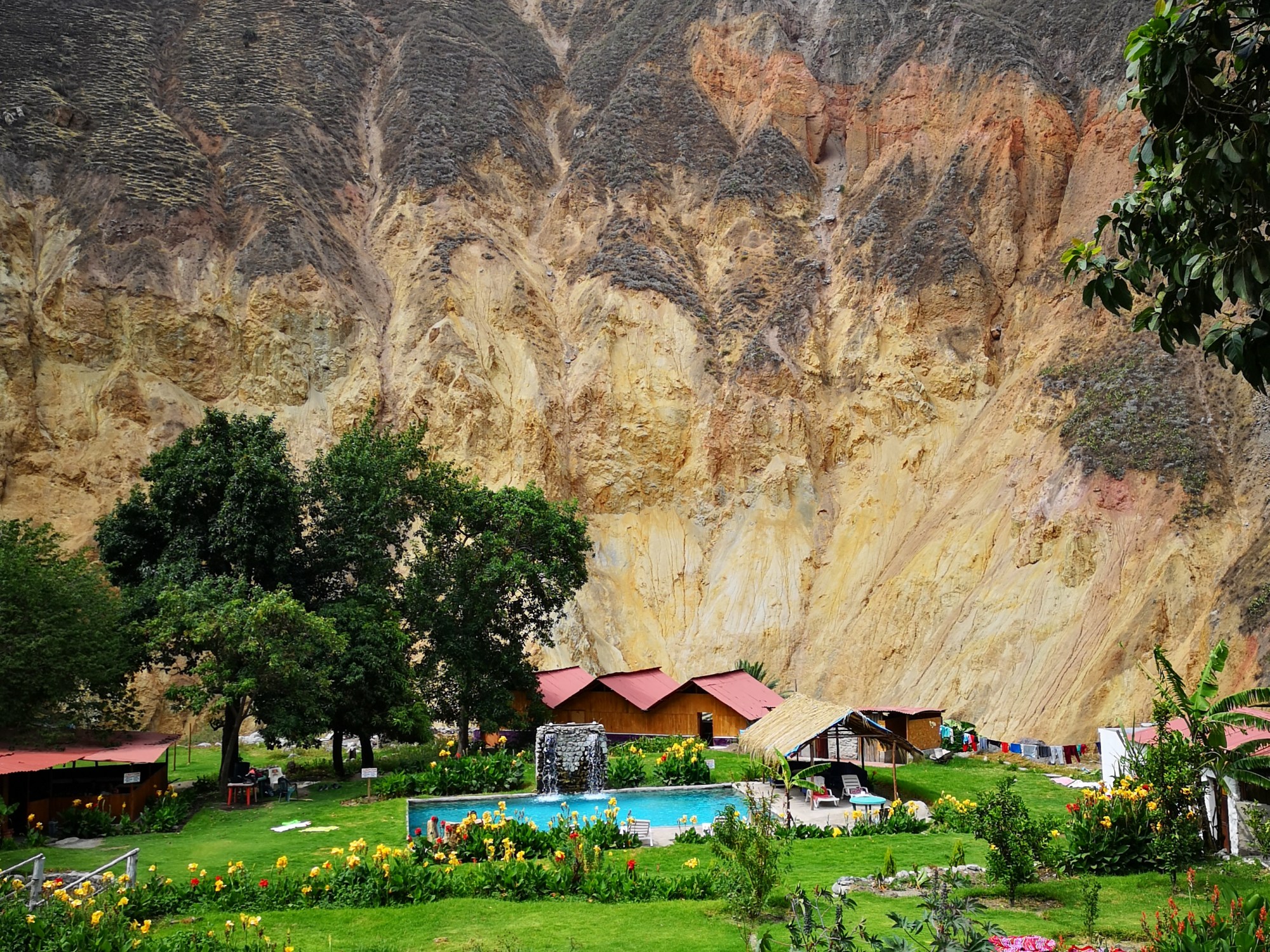
After the relaxing hike in Machu Picchu, it is now time for some hardcore hiking in the Colca Canyon. 😜
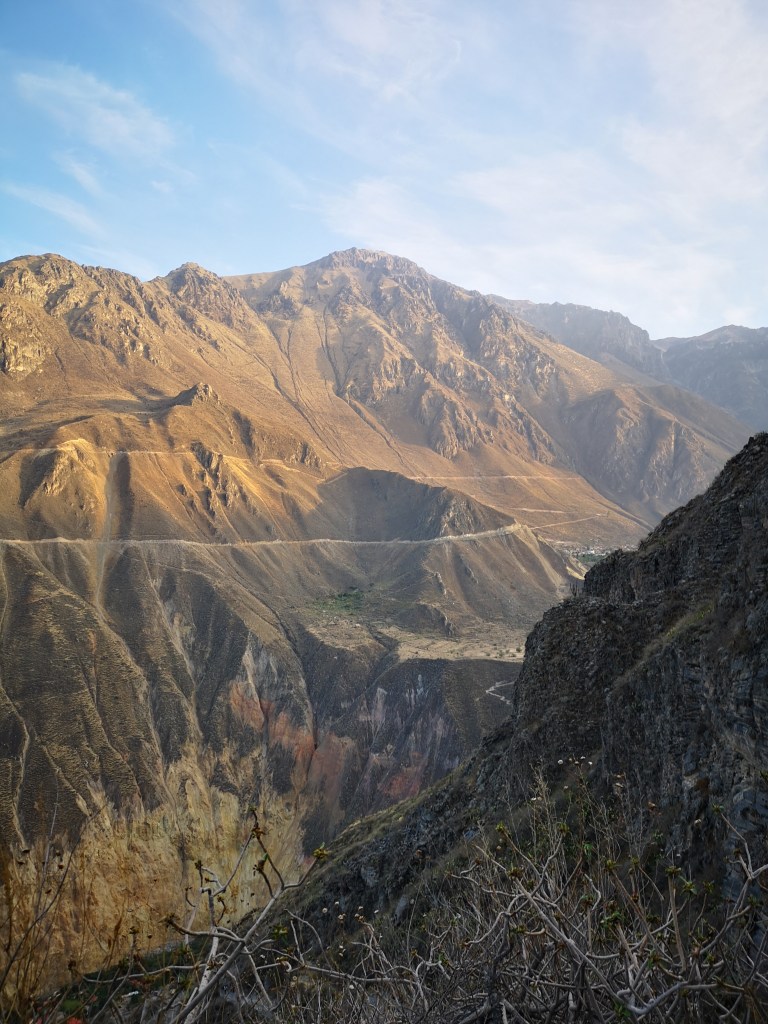
Colca Canyon, in the Arequipa region in Peru is said to the world’s second deepest canyon, approximately 3,400m at its deepest point (rim to rim), just a bit shallower than the nearby Cotahuasi Canyon and nearly twice as deep as the US’ Grand Canyon.
I know you are thinking – “yes right, twice as deep as the Grand Canyon, that’s impossible”. The reason why both you and I are correct is that when you visit the Grand Canyon, you are more or less at the top and you see this huge void below you. When you instead visit the Colca, your starting point is typically Chivay or Cabanaconde, which is only about 1.200 meters above the low point in the canyon, and you still have high mountains behind you. All clear?!? Let’s start then!
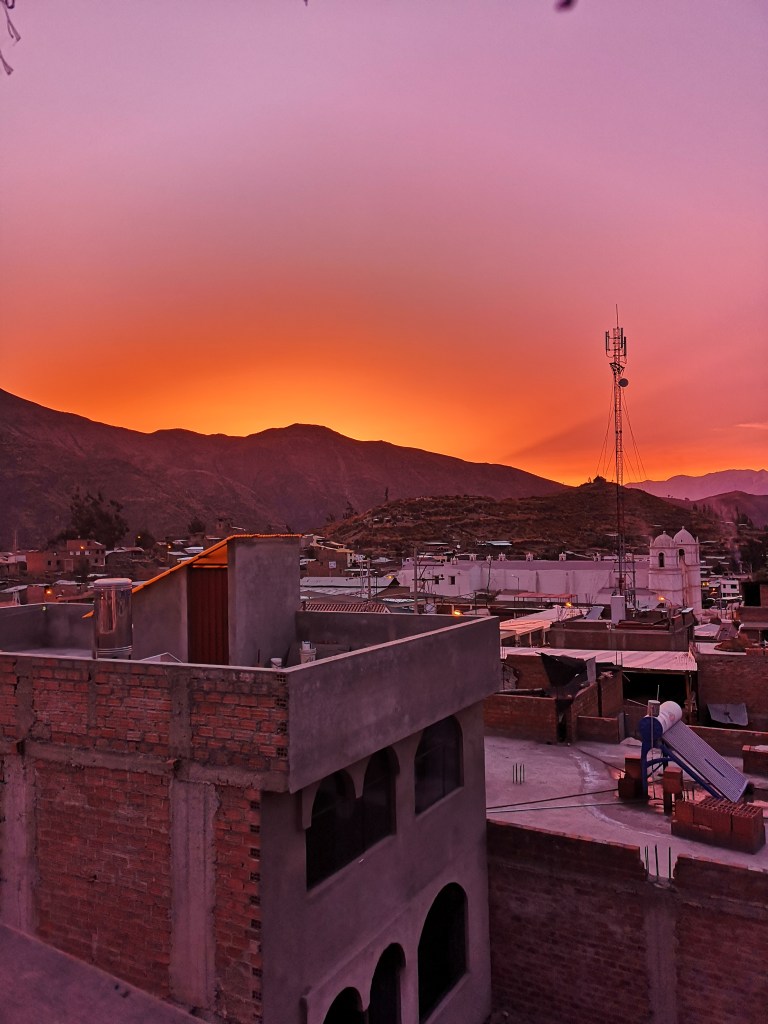
As for many travellers, our trip began in Cabanaconde (Pachamama hostel – really recommended). The Colca welcomed us with an amazing sunset which we enjoyed from the rooftop of the hotel – the light was changing so quickly and the sky coloured like a canvas.
—
Dopo il trekking rilassante a Machu Picchu, è ora di fare qualche escursione un po’ più intensa nel Canyon del Colca. 😜
Il Canyon del Colca, nella regione di Arequipa in Perù, si dice sia il secondo canyon più profondo del mondo, circa 3400 metri nel suo punto più profondo (da punto più alto a punto più basso), solo un po’ meno profondo del vicino Canyon Cotahuasi e quasi il doppio del Grand Canyon.
So che starete pensando – “come no, due volte più profondo del Grand Canyon, è impossibile”. Il motivo per cui sia io che voi abbiamo ragione è che quando visiti il Grand Canyon, sei in alto e vedi un enorme vuoto sotto di te. Quando invece visiti il Colca, il tuo punto di partenza è tipicamente Chivay o Cabanaconde, che si trova a circa 1.200 metri sopra il punto più basso del canyon, e hai ancora le montagne dietro di te. Tutto chiaro?!? Iniziamo quindi!
Come per molti altri, il nostro viaggio è iniziato a Cabanaconde (ostello Pachamama – davvero consigliato). Il Colca ci ha accolto con un tramonto incredibile dal tetto dell’hotel – la luce cambiava così rapidamente e il cielo si è colorato come una tela.
We articulated our hike in 3 days and 2 nights as shown in the map below (every day a different colour):
—
Abbiamo articolato la nostra escursione in 3 giorni e 2 notti, come mostrato nella mappa qui sotto (un colore diverso per ogni giorno)
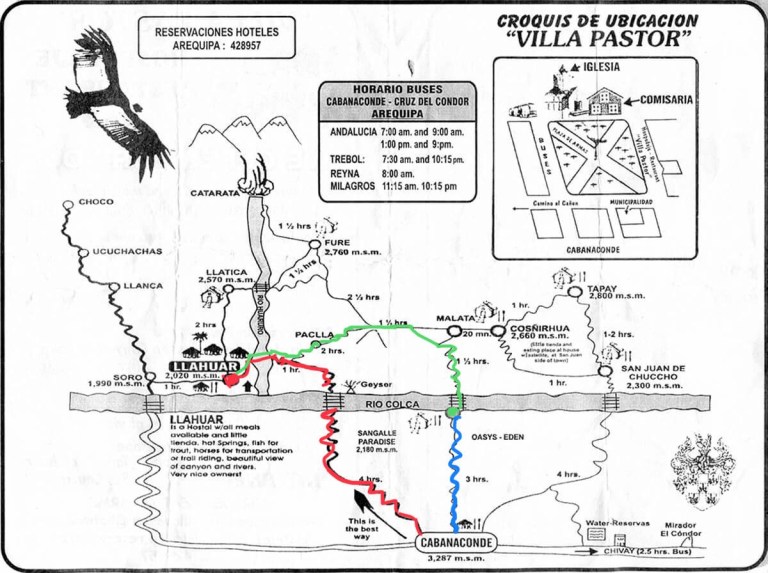
Day 1 (red): hike down 1,300 meters from Cabanaconde to Llahuar. We are told to start early as we are in the rainy season, when it is typically good weather in the morning and rains in the afternoon… So we engage in a nice descent (particularly friendly for our old knees) – the air is very dry and we enjoy alternating sauna-scented air and fresh breezes. We also pass by modern and less modern bridges, and with thunders in the background, we finally arrive in Llahuar, with the intention of setting up our own tent. We had not considered the abundance of small mosquitoes though, which immediately made us change our mind, so hostel room it is!
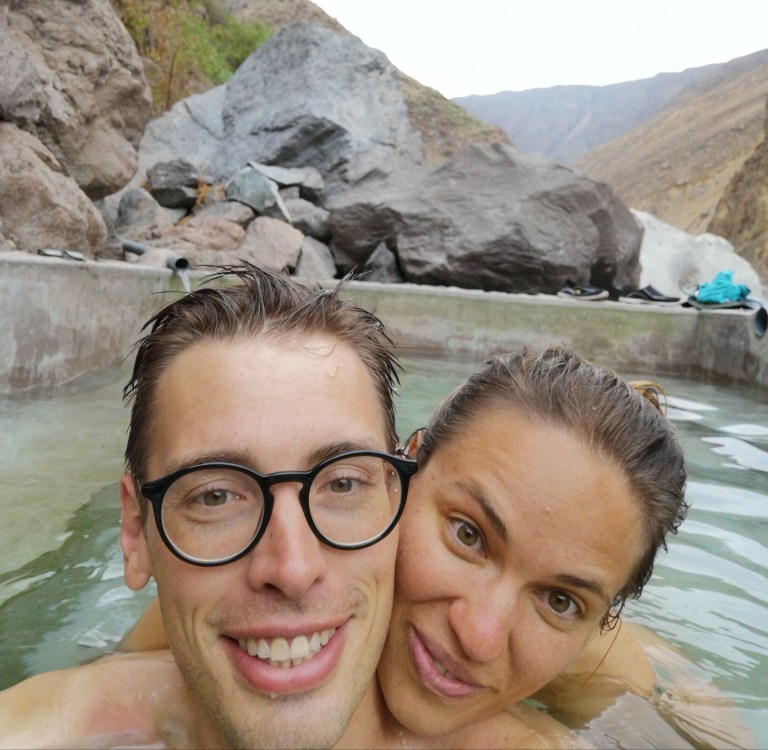
In Llahuar there are 2 hostels (and nothing else besides that btw). We picked one and got ready for our treat – thermal pools!!!! Because of the bad weather (it only rained a bit in the end) we were alone in the pools and enjoyed it in solitude 😎
—
Giorno 1 (rosso): escursione in discesa di 1300 metri da Cabanaconde a Llahuar. Ci viene detto di iniziare presto perché siamo nella stagione delle piogge, quando di solito è bel tempo al mattino e piove nel pomeriggio … Quindi ci impegniamo in una bella discesa (particolarmente piacevole per le nostre ginocchia anziane) – l’aria è molto secca; aria calda profumata che ricorda la sauna si alterna a brezza fresca. Attraversiamo ponti moderni e meno moderni, e con tuoni sullo sfondo, arriviamo finalmente a Llahuar, con l’intenzione di allestire la nostra tenda. Non avevamo considerato l’abbondanza di piccole zanzare però, che ci ha fatto subito cambiare idea, quindi decidiamo di prendere una stanza dell’ostello!
A Llahuar ci sono 2 ostelli (e nient’altro oltre a quello). Ne abbiamo scelto uno e ci siamo preparati per le piscine termali !!!! A causa del maltempo (ha piovuto solo un po’ alla fine) eravamo soli nelle piscine che ci siamo goduti in solitudine 😎
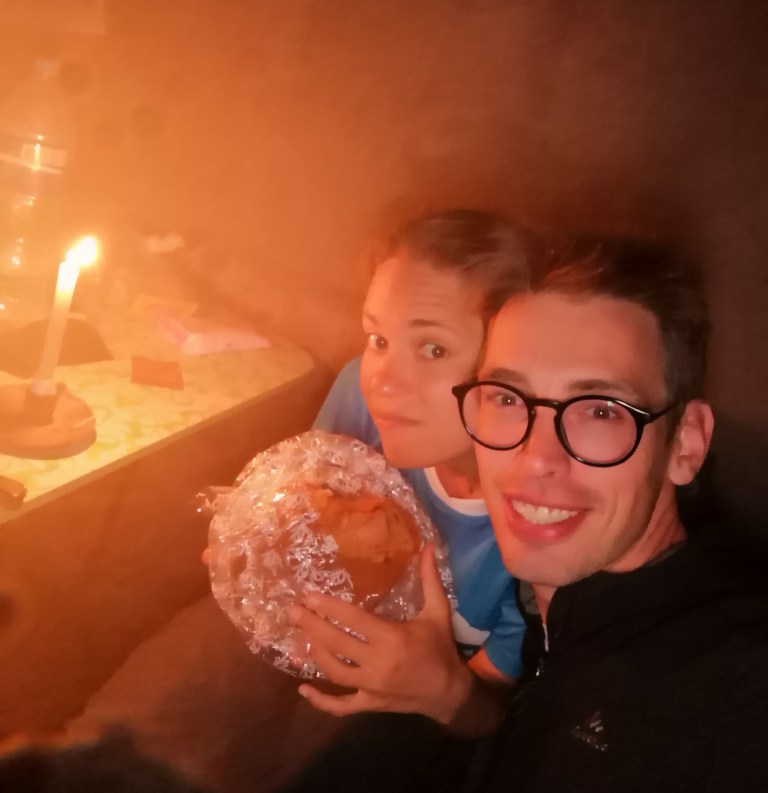
After a simple dinner prepared by the hostel, we indulged in panetton in our room at candlelight
—
Dopo una cena semplice preparata dall’ostello, ci siamo concessi un panettone nella nostra stanza a lume di candela
Day 2 (green):Ready for some walk in the Canyons! As we pass the small (mostly uninhabited) village of Turuna, we realise we have a dog as a new friend, who is really really keen to accompany us on our journeys (until the end of the hike in day 3!)
The day is very warm and we need to walk for c. 5 hours to the other side of the canyon, passing by Paclla, Belen and the Mirador de Apacheta, to reach Sangalle. We are surprised by the variety of colours the rock has, but are unable to capture it in pictures properly.
—
Giorno 2 (verde): pronti per una passeggiata nei Canyon! Mentre attraversiamo il piccolo villaggio (per lo più disabitato) di Turuna, ci rendiamo conto di avere un cane come nuovo amico, che è davvero entusiasta di accompagnarci nei nostri viaggi. (E sarà con noi fino alla fine del trekking il giorno 3!)
La giornata è molto calda e dobbiamo camminare per c. 5 ore passando per Paclla, Belen e il Mirador de Apacheta, per raggiungere Sangalle. Siamo sorpresi dalla varietà di colori delle rocce, ma non siamo in grado di catturarli degnamente in foto.

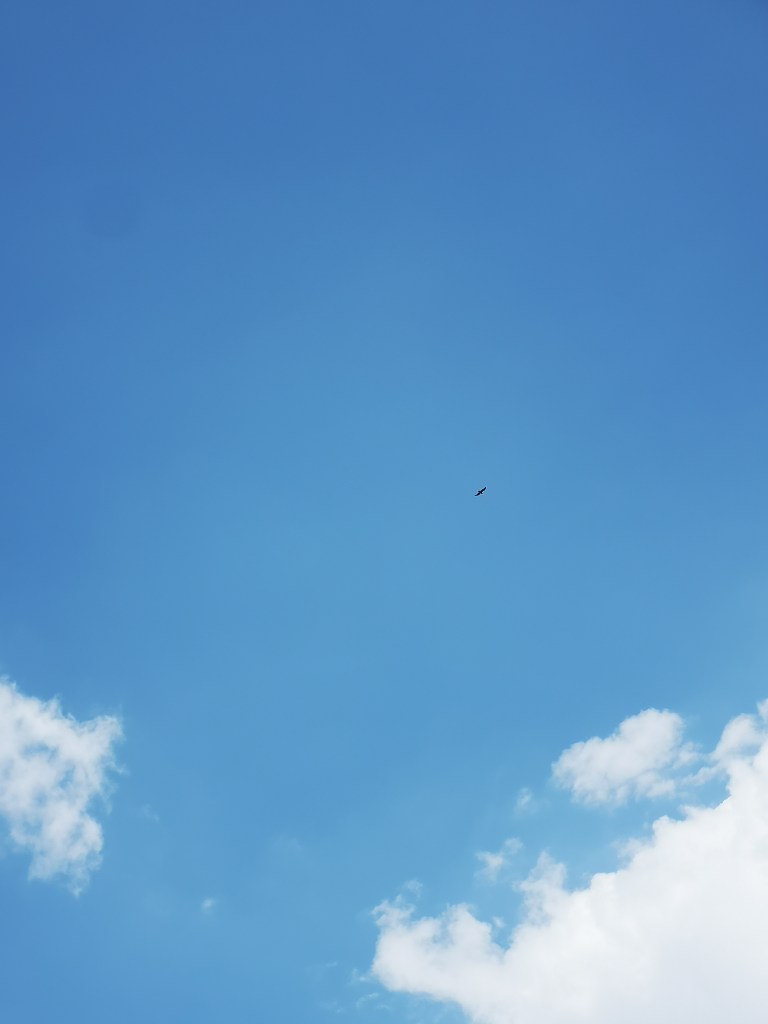
The canyon is home of the condor, which some lucky photographers are able to capture close by. We might have spotted one, but given the distance it could be any other bird to be honest.
—
Il canyon è la casa del condor, che alcuni fortunati fotografi riescono a catturare da vicino. Potremmo averne individuato uno, ma considerata la distanza, potrebbe essere stato qualsiasi altro volatile.

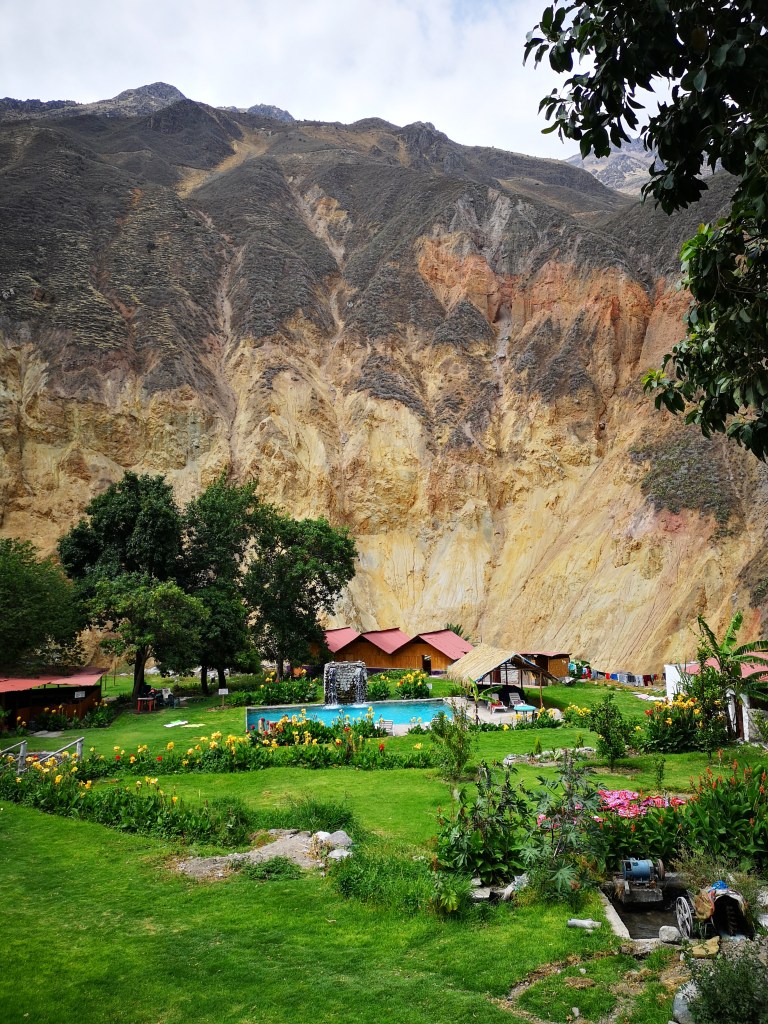
The rocky landscape is interrupted by the oasis of Sangalle, which looks surreal and we wonder if the sun has been perhaps too strong and we are daydreaming. But, as we walk the oasis approaches and we finally get to it! It is real and we immediately dive in a swimming pool at one of the hotels/hostels there.
—
Il paesaggio roccioso è interrotto dall’oasi di Sangalle, che sembra surreale e ci chiediamo se il sole sia stato forse troppo forte e stiamo sognando ad occhi aperti. Ma, mentre camminiamo, l’oasi si avvicina e finalmente arriviamo! È vera e ci immergiamo subito in una piscina in uno degli hotel / ostelli lì.
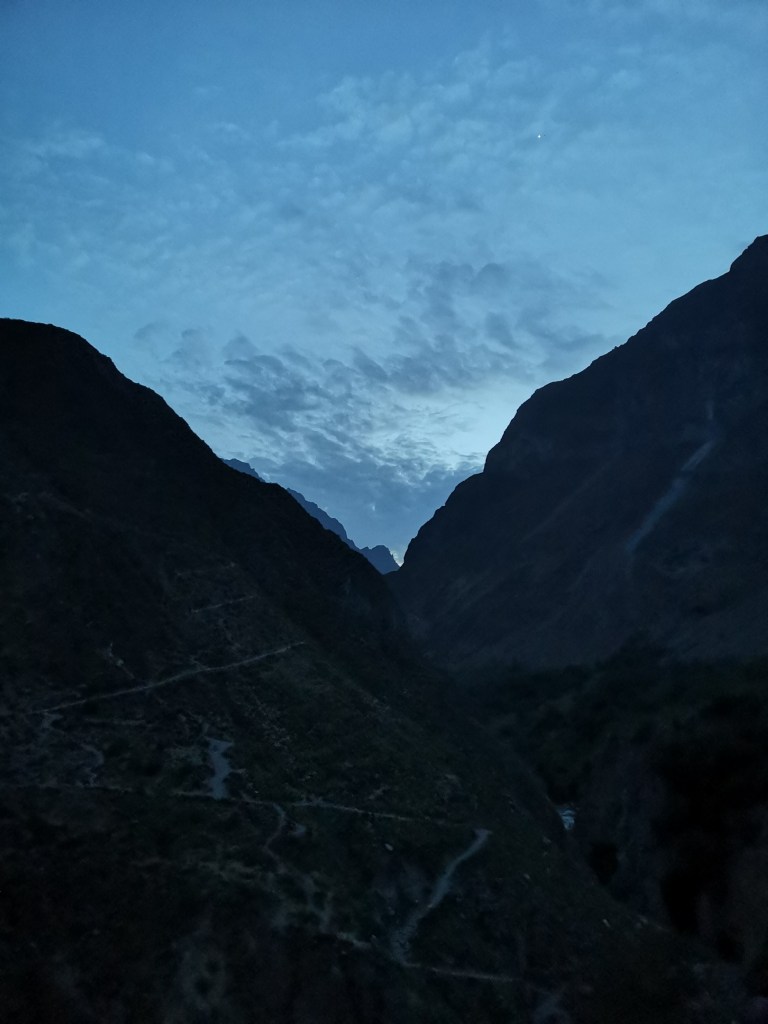
Day 3 (blue): Today we need to be at the hostel by 9 to take the bus to Arequipa. The walk up is said to take c.3 hours to go up about 1200m so we allow some extra time and we “hit the mountain” at 4.45am – it is almost dark outside but we are not the only ones walking up… in hindsight, it is highly recommended to start that early as in that way you completely avoid hiking in the sun, which can be tough as you are continuously going up.
The canyon at sunrise looks surreal…
—
Giorno 3 (blu): oggi dobbiamo essere in ostello alle 9 della mattina per prendere l’autobus per Arequipa. Il percorso in salita dura circa 3 ore e mezza, quindi ci concediamo un po’ di tempo in più e partiamo alle 4:45 – è quasi buio fuori ma non siamo gli unici a camminare … con il senno di poi, si consiglia vivamente di iniziare così presto per evitare il sole, che non aiuta di certo in salita. Il canyon all’alba sembra surreale …
Interesting fact about the outfit of women in the Colca region: they wear very elaborate and colourful garments and their hats are unique to the region; they cannot be found elsewhere in Peru and can only be with a black or white base according to the village the woman is from. We enquired about the prices and a full outfit can cost hundreds of dollars as it is bespoke and handmade… and local people save an entire year to buy a new one. But they really look beautiful!
—
Curiosità sugli abiti delle donne nella regione del Colca: indossano indumenti molto elaborati e colorati e il loro cappello è unico nella regione; non possono essere trovati da nessuna altra parte in Perù e possono essere solo con una base nera o bianca, secondo il villaggio da cui proviene la donna. Chiediamo informazioni sui prezzi e un vestito completo può costare centinaia di dollari perché è fatto su misura e a mano … la gente del posto risparmia un anno intero per comprarne uno nuovo. Ma sono davvero belli!

Final thoughts on Colca: the landscape, thermal baths and oasis are really amazing but be prepared for very dry weather and strong direct sun. Start walking in the very early morning to avoid being cooked and if you happen to travel in the rain season do not forget the bug spray!
—
Pensieri finali sul Colca: il paesaggio, i bagni termali e le oasi sono davvero incredibili, ma preparatevi a condizioni climatiche molto secche e ad un forte sole diretto. Cominciate a camminare la mattina molto presto per evitare di essere cotti dal sole e se vi capita di viaggiare nella stagione delle piogge non dimenticate lo spray contro le zanzare!
 Maria & Serge